Already booked?
Fill in your passenger register before we sail.
About your charter
Is the charter private?
Yes. Liquid Desire is a private sailing charter, so the yacht, the crew and the day are yours. We take small private groups of up to 11 guests for day trips and 4 to 6 for overnight trips.
What's included?
Your skipper and crew, snorkelling gear, and meals from our private chef, made to suit your tastes. We provide stinger suits, wet suits, soft drinks, fishing gear, paddle boards, towels. Tell us about any allergies, dietary needs or medical conditions when you book.
Where do we leave from?
Liquid Desire departure and return point is the public pontoon in Ashford Avenue. Not the marina. Use the map and link on the website. Or type in Ashford Avenue to Google. Please arrive 15 minutes before departure.
Can I bring alcohol?
Yes. Bring your own alcoholic drinks; we will have a fridge or esky for them.
Are children welcome?
Yes. Families love a private charter because you set the pace. Child-size snorkel gear is on board plus stinger suits and wetsuits. We also have noodles and life jackets.
I've never snorkelled. Is that okay?
Yes, this is generally no problem. The crew gives a full briefing, fits your gear and manages the process until you're comfortable. Flotation aids are available for anyone who wants extra support. The drift snorkelling requires you to have a reasonable level of fitness as you will be away from the main vessel and need to be able to get in and out of the inflatable dinghy in open water.

What should I bring?
What should I bring?
Just the personal things. We supply the snorkelling gear and food.
- Swimwear.
- A dry change of clothes
- Hat and polarised sunglasses
- Reef-safe sunscreen (mineral, zinc-based)
- A light jacket sometimes from June to August, when mornings on the water are cool
- Any medication you need, including seasickness tablets if you're prone to it
- Camera or phone in a waterproof case
Snorkelling
What is drift snorkelling?
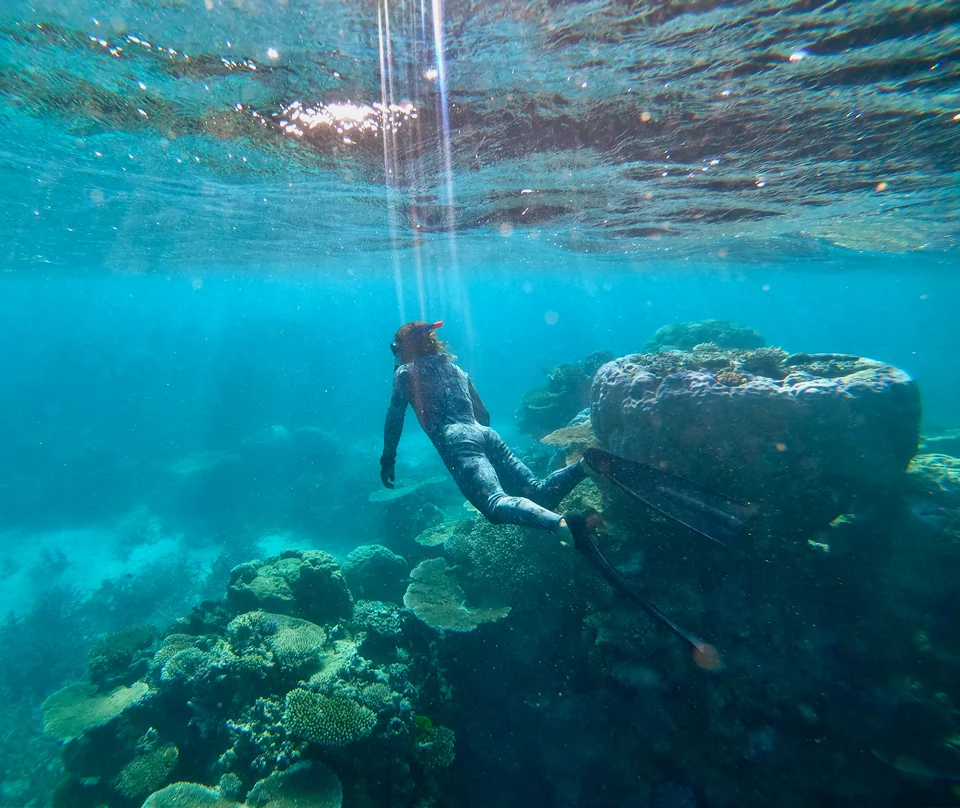
Drift snorkelling lets the tide and the wind do the work. We drop you in the water up-current of the reef edge, then you snorkel and let the current carry you along the coral edge. The tender and guide lead the way and pick you up at the end of the run, so there's no swimming back upwind.
Because you barely need to kick, you cover far more reef than on a normal snorkel, with very little effort. It also suits less confident swimmers. A crew member watches the group the whole time, and we only drift when the tide and conditions suit.
Will I see turtles?
Green and hawksbill turtles are often seen around our reef sites, along with reef fish, giant clams and coral gardens. Wildlife is wild, so we can't guarantee any sightings.
Do I need to be a strong swimmer?
It is useful to be comfortable in the water. We do regard our trips as reasonably adventurous. If you are not a strong swimmer, we will manage with either flotation devices or a guide if possible. Flotation vests and noodles are on board.
Weather and comfort
What's the weather like in Port Douglas from May to January?
Warm all season. June to October is the dry season: sunny days, low rainfall and the clearest water. From December the wet season builds, with hotter, humid days and afternoon storms.
Swipe across the table to read all four columns.
| Months | Day / night air (°C) | Water (°C) | What to expect |
|---|---|---|---|
| May | 27–29 / 20–23 | about 24 | End of the wet season. Rain eases off, days warm and settled. |
| June – August | about 25 / 17 | about 22 | Dry season. Sunny, mild days and cool mornings. Southeast trade winds can make the water choppy. Sometimes 20 to 25 knots with bumpy seas and rain squalls. |
| September – October | up to 29 / 22 | about 26 | Dry and calm. Often the best visibility of the year. Monthly rain 50 mm or less. Regarded as the best months. |
| November | about 29 / 22 | 27–28 | Hot and getting humid. Stinger season has usually begun. |
| December – January | about 30 / 23 | about 29 | Wet season. Hot and humid, with tropical downpours. About 200 mm of rain in December and 400 mm in January. |
Figures are seasonal averages (Experience Oz). The May and November water temperatures sit between the seasonal figures.
What about stingers (marine jellyfish)?
Stinger season in tropical Queensland runs roughly from November to May. During those months, we provide full-length lycra stinger suits and we recommend everyone wears one in the water. They also protect against sunburn. Our crew carry vinegar and are trained in first aid.
Will I get seasick?
A sailing yacht moves more gently than a fast powerboat; the sails stabilise the vessel, and the ride is smoother. We choose sheltered spots where we can. If you're prone to motion sickness, take a tablet about an hour before boarding. Stay on deck looking at the horizon, and tell the crew if you feel unwell.
Fishing
Can I fish?
Yes, in the right places. Trawling is best suited to the yacht. We have some rods and tackle but fishing is a side activity not a focus. We occasionally get lucky and catch lunch or dinner. We fish only where the Great Barrier Reef Marine Park zoning allows it, and the focus is on soft plastics and lures. Bait fishing is not the focus.
Green zones (Marine National Park): no fishing. Low Isles is one. Fishing is banned in its lagoon and the buffer around the islands.
Queensland bag and size limits apply to everything kept. Undersize or protected fish go back gently.
Zoning rules from GBRMPA zoning maps.
Reef health
How is the reef health?
The northern Great Barrier Reef, our backyard, is in better shape than many people expect. The Australian Institute of Marine Science surveyed 121 reefs between August 2025 and June 2026. Its August 2026 report found average hard coral cover in the northern region rose to 35.1%, up from 30.0% a year earlier. That's above the long-term average of 27%.
The reef still faces real pressure. Warm water caused some bleaching in February 2026, though surveys found it was low overall, and crown-of-thorns starfish outbreaks are being watched. We choose sites with the best coral on the day, and every guest leaves knowing how to help.
Source: AIMS Great Barrier Reef condition summary 2025–26.
How can I help protect the reef?
- Use reef-safe, mineral sunscreen.
- Never stand on or touch coral, and keep fins up off the bottom.
- Don't feed or chase marine life.
- Take all rubbish home.
Bookings and weather
What if the weather is bad?
Your safety comes first. If the captain cancels on safety grounds, the Charterer may choose a postponement or full refund. Insurance covering this scenario is strongly recommended.
Do I need to book ahead?
Yes. We take one private group at a time, so dates fill quickly, especially from June to October.
When do I pay, and what if I cancel?
To hold a date you will need to put down a 50% deposit. The final payment is due 30 days prior to the trip.
Cancellations must be made in writing. Remote expeditions involve significant advance commitments; cancellations are subject to the following retention schedule:
- More than 30 days before departure — deposit refunded less $200 administrative fee.
- 10–30 days before departure — 50% of charter value retained
- Within 10 days of departure — 100% of charter value retained
Can guests with limited mobility come aboard?
Most of the time. Please call us before booking so we can talk through access to the yacht and the water.
How do I contact you?
Call 0438 877 783 or anthony@liquiddesire.com
Plan your charter
Custom charters. We offer custom charters, from family trips to research trips and everything in between. Tell us what you have in mind, and we’ll tailor it to your group.
+61 438 877 783anthony@liquiddesire.com