
These stories recall earlier voyages. Travel details and practical information reflect the time of writing.
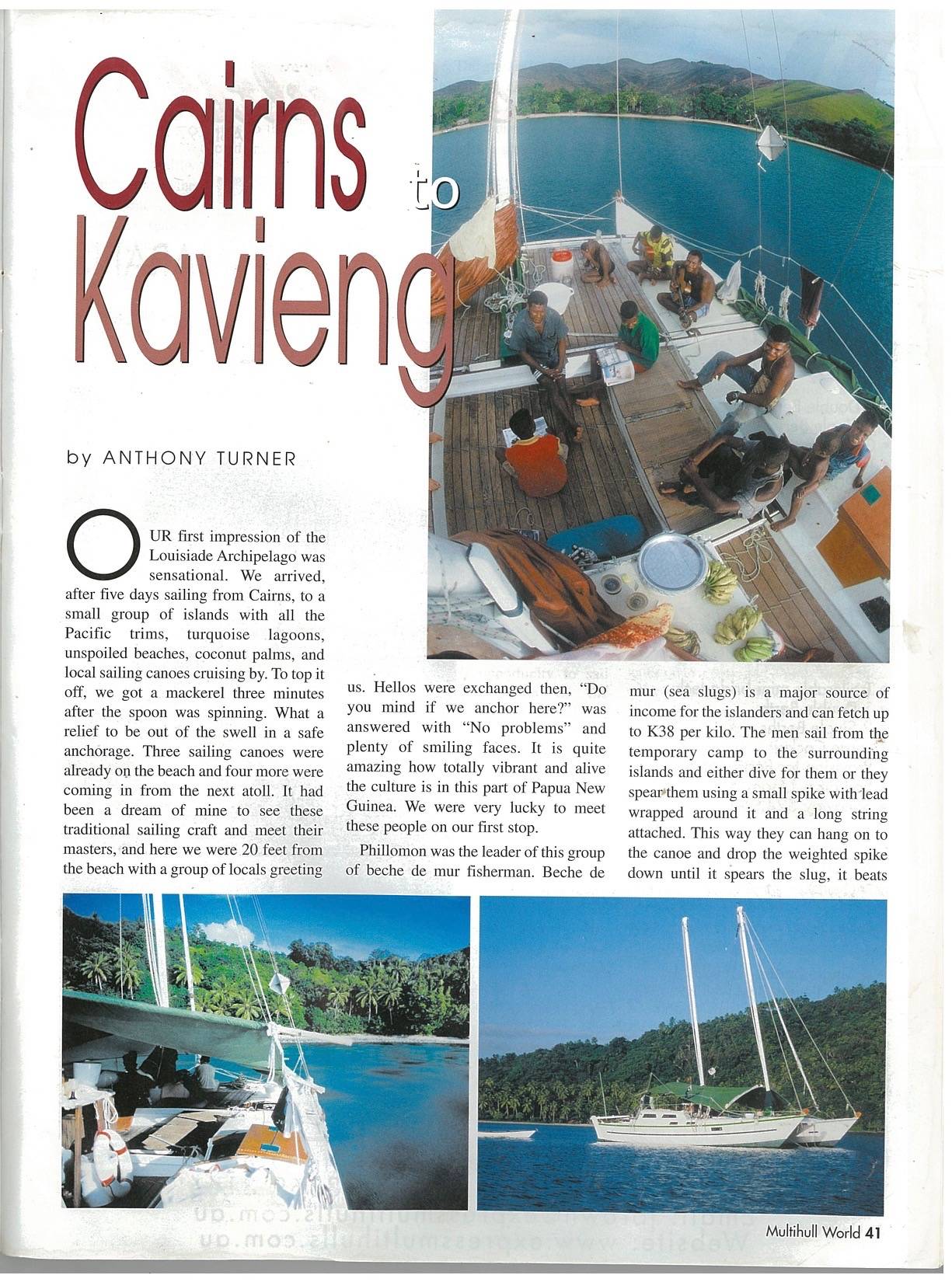
OUR first impression of the Louisiade Archipelago was sensational. We arrived, after five days sailing from Cairns, to a small group of islands with all the Pacific trims, turquoise lagoons, unspoiled beaches, coconut palms, and local sailing canoes cruising by. To top it off, we got a mackerel three minutes after the spoon was spinning. What a relief to be out of the swell in a safe anchorage. Three sailing canoes were already on the beach and four more were coming in from the next atoll.
It had been a dream of mine to see these traditional sailing craft and meet their masters, and here we were 20 feet from the beach with a group of locals greeting us. Hellos were exchanged then, “Do you mind if we anchor here?” was answered with “No problems” and plenty of smiling faces. It is quite amazing how totally vibrant and alive the culture is in this part of Papua New Guinea. We were very lucky to meet these people on our first stop.
Phillomon was the leader of this group of beche de mur fisherman. Beche de mur (sea slugs) is a major source of income for the islanders and can fetch up to K38 per kilo. The men sail from the temporary camp to the surrounding islands and either dive for them or they spear them using a small spike with lead wrapped around it and a long string attached. This way they can hang on to the canoe and drop the weighted spike down until it spears the slug, it beats diving 60 foot for them!
They are then gutted and boiled in a pot then dried over a fire ready for the market, which is in Alatau 250 nautical miles to the north-west. The stocks of bech de mur seemed to be healthy possibly due to the government-controlled season, approximately January to May. So most villages try to collect as many as possible in the season to help with school fees and other expenses. PNG is a little expensive once you step out of the garden.
We became good friends with these Motorina Island people over the four or five days we spent there. Soccer is very popular and the dust and sand flew every afternoon as the young men displayed skills Pele would be proud of. Not an ounce of fat and all muscle. The guitars were brought ashore and the music didn’t stop until the very early hours of the morning. These islanders could dance. The rhythm of the guitars and the singing was pure bliss. Occasionally the hula-hula would make a cameo appearance and laughter would be heard for miles.
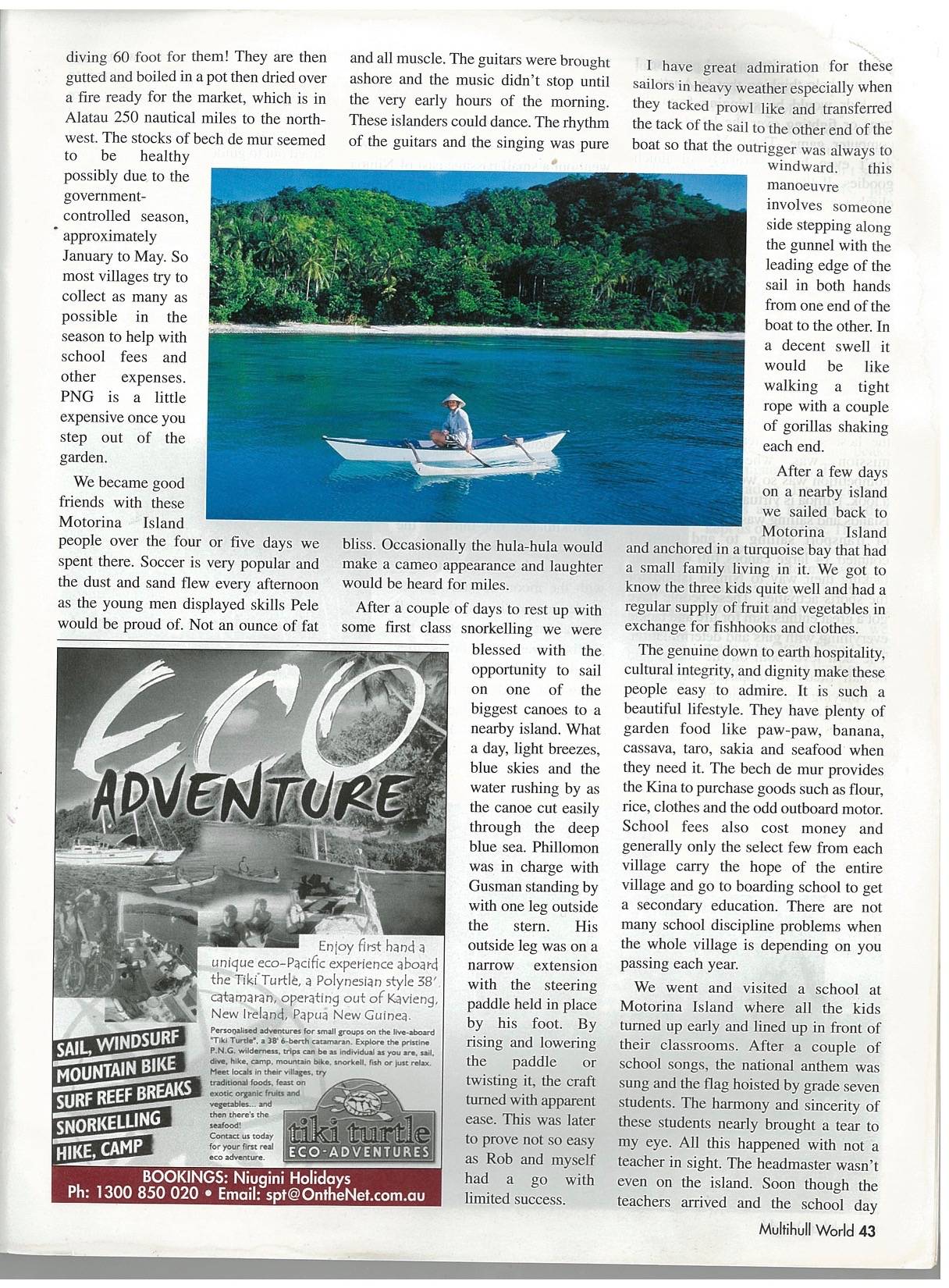
After a couple of days to rest up with some first class snorkelling we were blessed with the opportunity to sail on one of the biggest canoes to a nearby island. What a day, light breezes, blue skies and the water rushing by as the canoe cut easily through the deep blue sea. Phillomon was in charge with Gusman standing by with one leg outside the stern. His outside leg was on a narrow extension with the steering paddle held in place by his foot. By rising and lowering the paddle or twisting it, the craft turned with apparent ease. This was later to prove not so easy as Rob and myself had a go with limited success.
I have great admiration for these sailors in heavy weather especially when they tacked prowl like and transferred the tack of the sail to the other end of the boat so that the outrigger was always to windward. this manoeuvre involves someone side stepping along the gunnel with the leading edge of the sail in both hands from one end of the boat to the other. In a decent swell it would be like walking a tight rope with a couple of gorillas shaking each end.
After a few days on a nearby island we sailed back to Motorina Island and anchored in a turquoise bay that had a small family living in it. We got to know the three kids quite well and had a regular supply of fruit and vegetables in exchange for fishhooks and clothes.
The genuine down to earth hospitality, cultural integrity, and dignity make these people easy to admire. It is such a beautiful lifestyle. They have plenty of garden food like paw-paw, banana, cassava, taro, sakia and seafood when they need it. The bech de mur provides the Kina to purchase goods such as flour, rice, clothes and the odd outboard motor. School fees also cost money and generally only the select few from each village carry the hope of the entire village and go to boarding school to get a secondary education. There are not many school discipline problems when the whole village is depending on you passing each year.
We went and visited a school at Motorina Island where all the kids turned up early and lined up in front of their classrooms. After a couple of school songs, the national anthem was sung and the flag hoisted by grade seven students. The harmony and sincerity of these students nearly brought a tear to my eye. All this happened with not a teacher in sight. The headmaster wasn’t even on the island. Soon though the teachers arrived and the school day began with commitment and purpose.
I couldn’t help thinking that in Australia the kids would be swinging from the trees or fighting over the latest pocket computer game. These Motorina kids don’t even have a variety of lunch goodies. If they want a sugar hit they climb a coconut tree.
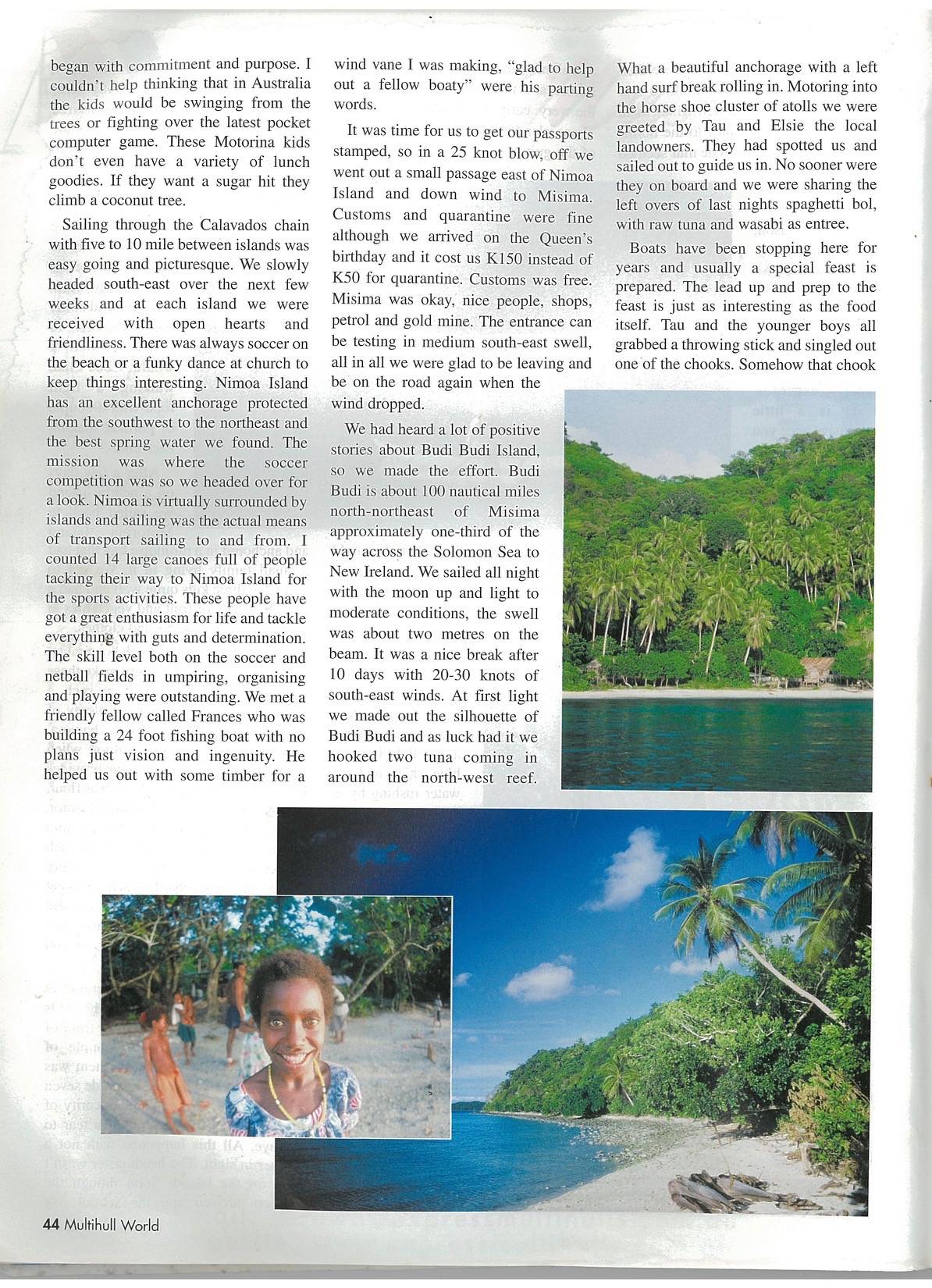
Sailing through the Calavados chain with five to 10 mile between islands was easy going and picturesque. We slowly headed south-east over the next few weeks and at each island we were received with open hearts and friendliness. There was always soccer on the beach or a funky dance at church to keep things interesting. Nimoa Island has an excellent anchorage protected from the southwest to the northeast and the best spring water we found. The mission was where the soccer competition was so we headed over for a look.
Nimoa is virtually surrounded by islands and sailing was the actual means of transport sailing to and from. I counted 14 large canoes full of people tacking their way to Nimoa Island for the sports activities. These people have got a great enthusiasm for life and tackle everything with guts and determination. The skill level both on the soccer and netball fields in umpiring, organising and playing were outstanding. We met a friendly fellow called Frances who was building a 24 foot fishing boat with no plans just vision and ingenuity.
He helped us out with some timber for a wind vane I was making, “glad to help out a fellow boaty” were his parting words.
It was time for us to get our passports stamped, so in a 25 knot blow, off we went out a small passage east of Nimoa Island and down wind to Misima. Customs and quarantine were fine although we arrived on the Queen’s birthday and it cost us K150 instead of K50 for quarantine. Customs was free. Misima was okay, nice people, shops, petrol and gold mine. The entrance can be testing in medium south-east swell, all in all we were glad to be leaving and be on the road again when the wind dropped.
We had heard a lot of positive stories about Budi Budi Island, so we made the effort. Budi Budi is about 100 nautical miles north-northeast of Misima approximately one-third of the way across the Solomon Sea to New Ireland. We sailed all night with the moon up and light to moderate conditions, the swell was about two metres on the beam. It was a nice break after 10 days with 20-30 knots of south-east winds. At first light we made out the silhouette of Budi Budi and as luck had it we hooked two tuna coming in around the north-west reef.
What a beautiful anchorage with a left hand surf break rolling in. Motoring into the horse shoe cluster of atolls we were greeted by Tau and Elsie the local landowners. They had spotted us and sailed out to guide us in. No sooner were they on board and we were sharing the left overs of last nights spaghetti bol, with raw tuna and wasabi as entree.
Boats have been stopping here for years and usually a special feast is prepared. The lead up and prep to the feast is just as interesting as the food itself. Tau and the younger boys all grabbed a throwing stick and singled out one of the chooks. Somehow that chook knows it’s time is up and the chase begins. I found this quite hilarious. Our feathered friend had the better of them for a while with some death defying moves but then Tau hit the target and the rest is history.
Elsie paddled to a nearby island and came back with 20 green paw-paws, which turned out to be the highlight of our feast. In short, she and Wendy peeled them and cut a small square in the side, emptied out the seeds and filled them with a grated coconut, then put the small square back in place. A fire was lit and stones were heated, then placed down as a base for the paw-paw. Green leaves were placed over the paw-paws with sand covering the lot, and a small coconut husk fire on top.
Two or three hours later, whala! The people of Budi Budi have no shop and a boat that comes irregularly so coconut is their mainstay. As we sat on Tau’s verandah the food was laid out, paw-paws, chicken, taro, sweet potato, sakia and coconut this and coconut that. It was divine!
Bob and I witnessed an amazing thing one day. We had taken the canoe down to the southeast surf break in the hope of finding a decent wave but unfortunately the swell had dropped out and we found ourselves rowing back. We passed an atoll on the way with two young girls and a broken outrigger scattered around their canoe. We stopped to see if we could help. The tukis (sticks that join the beams to the float) and one of the beams were broken.

It was just on dusk and we felt obliged to lend them a hand. They just looked at us and laughed. “We’re okay” came the bemused reply. They had a small fire going which they started themselves (no matches) and were burning the ends of the new tukis ready to hammer into the float. I didn’t see a knife or any tools, just ingenuity and hard core everyday survival skills. I felt useless standing around so we left them and paddled back to Tau’s village.
Sure enough half an hour later they arrived back at the village with beaming smiles.
Our two day trip across the Solomon Sea was pleasant and easy sailing until we got 30 or 40 miles off the big mountain peaks of Bougainville. That night we had a few lightning storms and heavy rain that kept us on our toes. The next day we were chased by a lightning storm with a whirly whirly in front of it for about an hour pushing us off course. Eventually we made it to Green Island after a hairy entrance through the reef on dusk.
One afternoon after been anchored in the lagoon for three days we had about a dozen canoes trading, playing guitars and looking at magazines and photos. Rob and Grat gave them a rendition of ‘Supermarket Church’ and I attempted some ‘Green Island Blues’ on the guitar while Wendy displayed her ‘savvy’ trade skills with the locals. A volleyball and some fish hooks were exchanged for fruit and vegies. However the people situation was becoming overwhelming. Grat had a great idea, a canoe race back to the village, and after much jostling and hustling for position there was about 15 canoes all lined up perfectly when the Aussie flag went down.
There was some serious paddling going on with quite a lot of bailing and laughing. A convenient way to say goodbye when privacy beckons.
From Green Island we sailed north-west through the chain of islands that were a comfortable 40 nautical miles apart. Some were flat atolls, others were huge mountains thousands of feet high. Tarzan country with ridges and valleys that looked impenetrable. We witnessed a young boy’s canoe being put together and paddled at the Feni Islands. His grandfather had made the canoe and had played an important role in the outrigger construction, passing on his ancient knowledge for the next generation. Once it hit the water you couldn’t get Sylvester or his younger brother Robby out of it.
Big beautiful grins ear to ear. Tanga Island had some exceptional snorkelling and interesting people, which was lucky because we copped a blow from the north-west for four days. It was very protected and allowed us time to explore the island on foot. There are always a few keen eight to 10 year olds willing to be ambassadors and guides.
Arriving at Lihir was like going to another country. A huge gold mine operation has made a massive impact to say the least. We were welcomed and got to know Rob, a yachty, who works as the Safety Officer there. He was a superb host and showed us around. After two months of nature we were suddenly surrounded by the 21st Century. The club has all the trims with swimming pool, international school and tennis court and a view to kill for. This was all nice on the outside but there certainly were some social problems with the local community and environmental issues that face these types of operations. I hadn’t seen any overweight nationals until we visited Lihir. Fried chicken, coke and ice-cream will do it every time.
It was time to fast track it to Kavieng, so we made fast work of the remaining 190 nautical miles. Spent a night at an all weather anchorage at Tabar Island then hit the mainland, New Ireland. We found some shallow water in Fangalava Bay and the biggest movement of people we had experienced to date. There were only two canoes so most people started swimming out. One guy floated on a rubber tube while another had a surfboard made of five small logs pinned together. It turned out to be a bit of a party with some nice music and the guitars on deck. I reckon 30 people were on board all interested in photos and stories. Apparently not many cruising boats stop here.
Kavieng! Well what a feeling to arrive at your destination and find what you had just imagined and more. If you started handing out prizes for friendliness then Kavieng locals would clean the table. It’s laid back, casual feel grows on you and I can imagine many a yachty enjoying the secure anchorage and the waterside markets. We anchored at the eastern end of Nusa Lik Island where a friend of mine Nick Keen and his brother and sister Shaun and Shannon run Nusa Island Retreat.
They cater for surfing, diving, fishing, and relaxing with traditional huts and excellent seafood. This is definitely the pick of the anchorages in the harbour, not too far from town, close to the safety of the local village and a stone’s throw from a cold beer and some good food.
There are a number of interesting things to do on New Ireland, the road system is excellent and you can ride or drive nearly all the way around the island. There are caves to be explored, a traditional shark calling festival in July, and some World War II wrecks in the harbour nearby. The surf in the wet season is great, and the islands out west are excellent for cruising with numerous anchorages, shallow water, and friendly people.
One day we took the kids from Nusa Lik Island out for a sail on the Tiki Turtle (Our boat). I counted 43 kids and seven adults. As we returned on dusk they sang a great rendition of ‘Jesus is a winner man, Satan is a loser man’, reverberating across the harbour.
We have been taken by Kavieng so much that we are starting a small Eco Adventure business there. We will cater for small groups who wish to sail, snorkel, sea kayak, surf, try traditional food or just relax. We will also use Kavieng as a take off point for our future trips north into Micronesia.
Customs, Quarantine, Immigration Info
It is best to obtain a visa before you enter PNG $133 for the skipper, $13 for crew.
Quarantine costs are K50. Don’t turn up on a public holiday, as it will cost you K150.
It is possible to extend your visa from two to three months, although you have to send your passports to Moresby.

If you have a large amount of honey or fresh produce it may be confiscated.
You need to clear in and clear out of each port you visit. By law you should contact police at each destination you stop at.
People
We approached this by having an open boat policy, locals were always very polite regarding boarding our boat, and we generally encouraged people to come onboard and have a look. This worked for us. In the three months cruising nothing went missing.
We found people friendly, hardworking and honest.
Reef
Be aware that the reef can go from 1000 foot to one foot in no time. (20m).
We found our draft allowed us to anchor in amongst the bomies on sand. Sometimes a stern anchor was used to avoid swinging around too much.
There are also times when we had no other choice but to anchor on top of the reef and hang back in 300 foot of water. Only when SE trades were blowing.
Trading
We found clothes and fishing equipment the best items for trade. Small fish hooks 4/0 and 3/0 and 60 pound line were popular. Spoon lures, trace and swivels were also sort after.
Soccer balls, rugby balls and volley balls were very popular.
Newspaper for rolling tobacco.
Tobacco - we carried none but it was asked for.
Batteries - D size.
Small swimming goggles.
Soap, dictionaries, books, pencils, pens, rubbers, colour paper and guitars.

Custom and Culture
It is appropriate to ask permission to anchor. Once the anchor is down, go ashore and see the chairman or chief, we always received a warm welcome.
The culture and language changed at each new place, it can be hard to keep up.
Some places like Kavieng and Milne Bay are matriarchal and women play an important roll in land ownership and decision making.
On some islands it is custom for a boy to receive a canoe on his path to manhood.
The men’s house also plays a significant roll for the initiation of boys to men. A long house is used for the training where young boys are instructed by there seniors. Pigs are killed and eaten and the intricate customs are many. You would need to spend a lot of time in PNG before being exposed to them.
People generally believe in the wantok system where anyone of your region/island is regarded as extended family (clan) and you are obliged to look out for them. This has caused some problems in Moresby where the youth are attracted to the big smoke and can end up out of work and dependent on their clan (wantok) to feed and house them.
Local Fruit and Vegie Trading
Nearly all of our fresh produce was bartered for with trade goods. The most common types of produce were: bananas, paw paws, wild cabbage [spinach], cassava, taro, sweet potato, sakia, eggs, chickens, cooking bananas, green and brown coconuts, yams, beans, pineapples, fish, crays, pomalows, oranges, limes, carambolas.
Our trading technique was normally along the lines of “What would you like for that”, we have fish hooks, cloths, books etc. We soon worked out the going rate and tried to be consistent and fair.
Weather
May proved to be a good time to leave Cairns. We had light winds which allowed us to head south-east till we were in the Willis Island area. The further south the better as you get a lot of easterlies. We had heaps of rain in June and I believe it can be one of the wettest months in the Louisaides. Once the SE trades kick in they can be just as strong as those in the Torres Straits.
Kavieng is only 2 degrees south of the equator and has variable weather between November and April (surf season) and east-southeast winds between April to November.
Beetle Nut
Papua New Guinea PK is chewed by most people, including some kids. It is a locally grown palm nut that is eaten with mustard (daka) which is a type of spicy vine, and crushed coral (lime). The three are eaten at once with the nut chewed and the mustard dipped into the lime and also chewed. The result is a red excess that is spat out and only the juice is swallowed. It is like a big coffee hit and is definitely handy when energy levels are low.
Original article pages
Plan your charter
Custom charters. We offer custom charters, from family trips to research trips and everything in between. Tell us what you have in mind, and we’ll tailor it to your group.
+61 438 877 783anthony@liquiddesire.com